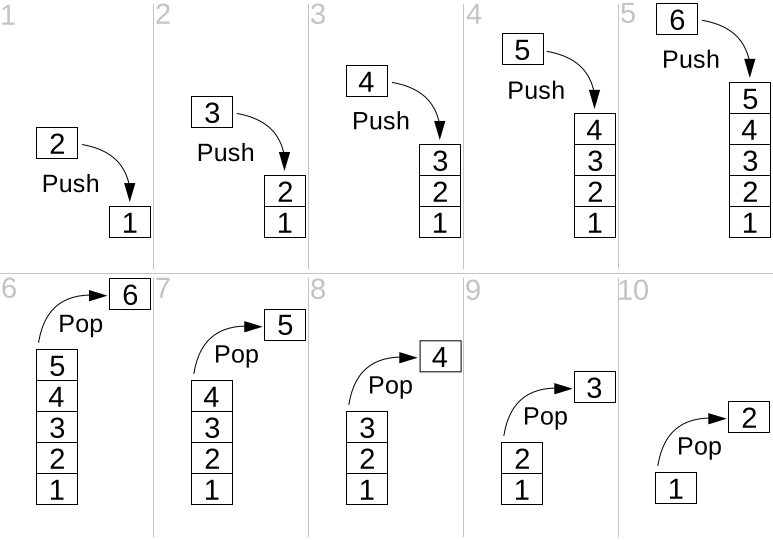
A stack is a linear data structure that follows the Last In, First Out (LIFO) principle. This means that the last element added to the stack is the first one to be removed. A stack can be thought of as a container that holds a collection of elements that can only be inserted into and removed from one end of the container.


Think of a stack of plates or cafeteria tray; the last plate you put on the stack is the first one you take off the stack. While arguably you can take a plate or tray in the middle of the stack, it would not be considered safe nor very efficient to do so.
A stack data structure supports at least these basic operations:
push- Adds an element to the top of the stack.pop- Removes the element at the top of the stack.peekorm_top- Returns the element at the top of the stack.is_empty- Returns true if the stack is empty, false otherwise.
Some implementations of a stack may also keep track of the size of the stack, which would allow the user to query the size of the stack. The stack data structure implementation in the C++ STL supports this operation. Implementation of stack data structure in this repository will also support this operation, as it is not a particularly difficult operation to implement, given that the stack will be wrapped in a class.
| Operation | Time Complexity |
|---|---|
push |
|
pop |
|
peek |
|
is_empty |
|
size |
As you can see, all of the operations on a stack are in constant time, which is a very efficient time complexity. This is because the stack only needs to access the same end of the stack, which is the top of the stack. This means that the stack does not need to traverse the entire stack to perform any of the operations, making it very efficient.
A stack can be implemented using an array with a determined maximum size, a linked list, or a dynamic array. In this repository, the stack will be implemented using a linked list. The linked list implementation of the stack will be wrapped in a template class, which will allow the user to use the stack with any data type. The class will keep track of the top of the stack and the size of the stack.
Because C++ template classes and methods can not be implemented in separate
.cpp files, the implementation of the stack will either be in the header
file itself or in a separate implementation file that will be included in
the header file. This repository will use the latter approach, using an
.ipp file as the implementation file.
Because the stack will be implemented using a linked list, the stack will need some kind of node with a link to store the data and link to the next node. The node will be implemented as a template struct, which will allow the user to use the stack with any data type. The node itself will be defined as a private member within the stack class to prevent the user from accessing the node directly.
template <typename T>
struct StackNode {
    T data;
    StackNode<T>* next;
};The stack class will be defined as a template class, which will allow the user to use the stack with any data type. The class will have the following private members:
m_top- A pointer to the top of the stack.m_size- The size of the stack.
The class will have the following public methods:
Stack- The constructor for the stack class.push- Adds an element to the top of the stack.pop- Removes the element at the top of the stack.peek- Returns the element at the top of the stack.is_empty- Returns true if the stack is empty, false otherwise.size- Returns the size of the stack.~Stack- The destructor for the stack class.
template <typename T>
class Stack {
private:
    template <typename U>
    struct StackNode {
        U data;
        StackNode<U>* next;
    };

    StackNode<T>* m_top;
    std::size_t m_size;

public:
    Stack();

    void push(const T& value);
    void pop();

    const T& peek() const;

    bool is_empty() const;
    std::size_t size() const;

    ~Stack();
};The constructor for the stack class will initialize the m_top pointer to nullptr
and the m_size to 0.
template <typename T>
Stack<T>::Stack() {
    m_top = nullptr;
    m_size = 0;
}The push method will add an element to the top of the stack. The method will
create a new node with the data passed in as a parameter and link it to the top
of the stack. The method will then update the m_top pointer to point to the new
node and increment the m_size by 1.
template <typename T>
void Stack<T>::push(const T& value) {
    StackNode<T>* newNode = new StackNode<T>;
    newNode->data = value;
    newNode->next = m_top;
    m_top = newNode;
    m_size++;
}The pop method will remove the element at the top of the stack. The method will
check if the stack is empty, if it is, it will throw an exception. If the stack
is not empty, the method will create a temporary pointer to the top of the stack
and update the m_top pointer to point to the next node in the stack. The method
will then delete the temporary pointer and decrement the m_size by 1.
template <typename T>
void Stack<T>::pop() {
    if (is_empty()) {
        throw std::underflow_error("Stack is empty.");
    }

    StackNode<T>* previousTopElement = m_top;
    m_top = m_top->next;
    delete previousTopElement;
    m_size--;
}The peek method will return the element at the top of the stack.
template <typename T>
inline const T& Stack<T>::peek() const {
    return m_top->data;
}The is_empty method will return true if the stack is empty and false otherwise. The
method will check if the m_size is 0, if it is, it will return true, otherwise
it will return false.
template <typename T>
inline bool Stack<T>::is_empty() const {
    return m_size == 0;
}The size method will return the size of the stack. The method will return the
m_size value.
template <typename T>
inline std::size_t Stack<T>::size() const {
    return m_size;
}The destructor for the stack class will delete all of the nodes in the stack. The
method will create a temporary pointer to the top of the stack and update the
m_top pointer to point to the next node in the stack. The method will then delete
the temporary pointer and decrement the m_size by 1. The method will continue
to do this until the stack is empty.
template <typename T>
Stack<T>::~Stack() {
    while (!is_empty()) {
        StackNode<T>* previousTopElement = m_top;
        m_top = m_top->next;
        delete previousTopElement;
        m_size--;
    }
}The stack class will not be tested using some kind of unit testing framework.
Instead, the stack class will be tested using a simple main function in a separate
.cpp file. The main function will perform some operations on the stack and
print the results to the console. The code for the main function can be found
in the demo.cpp file. Feel free to play around with the code and modify it
according to your needs.