Skip to content

Fault slip test case - #2245

Closed
CusiniM wants to merge 44 commits into
developfrom
cusini-aleks/feature/faultSlip
Closed

CusiniM wants to merge 44 commits into
developfrom
cusini-aleks/feature/faultSlip

Conversation

@CusiniM

@CusiniM CusiniM commented Jan 16, 2023

Copy link
Copy Markdown
Collaborator

No description provided.

@av-novikov

Copy link
Copy Markdown
Contributor

Hi Matteo,

  1. I fixed the reservoir geometry (width=225, offset=75) and applied the Neumann condition for the top boundary according to the benchmark.

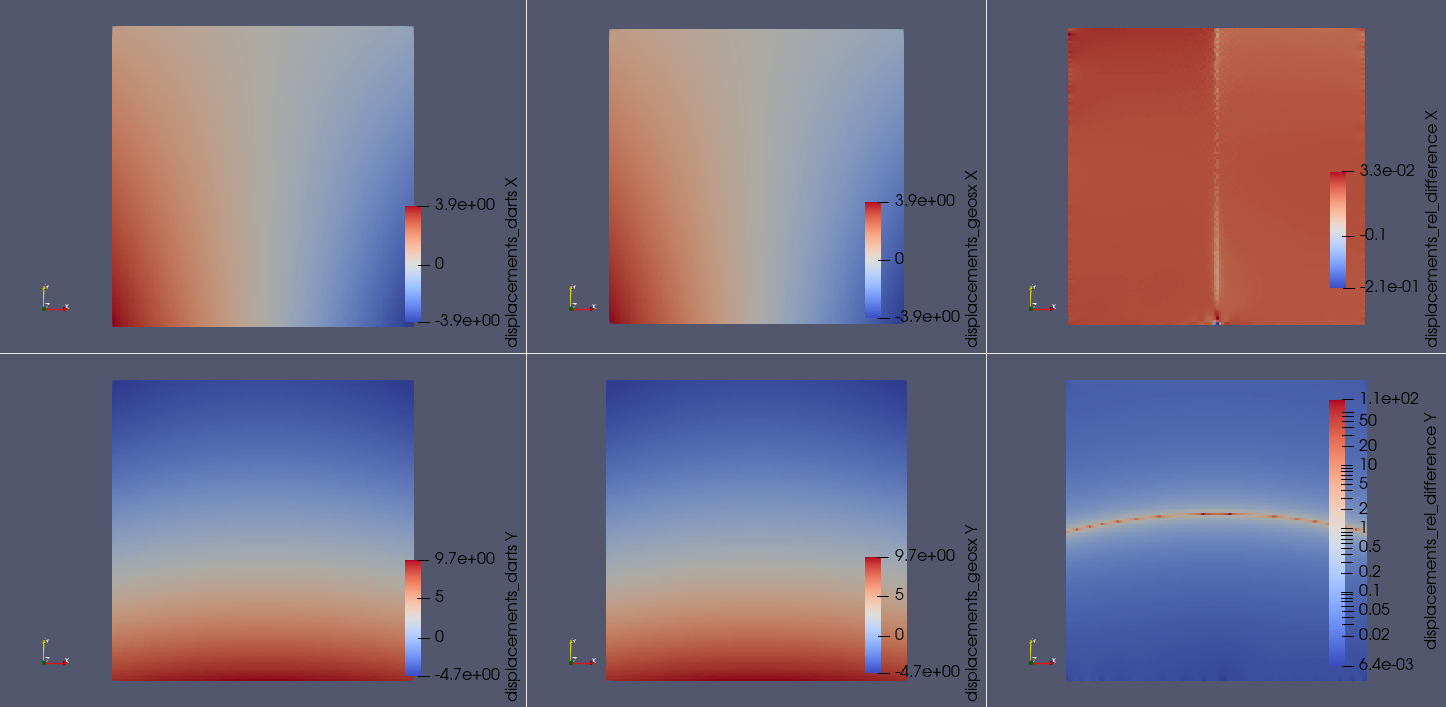
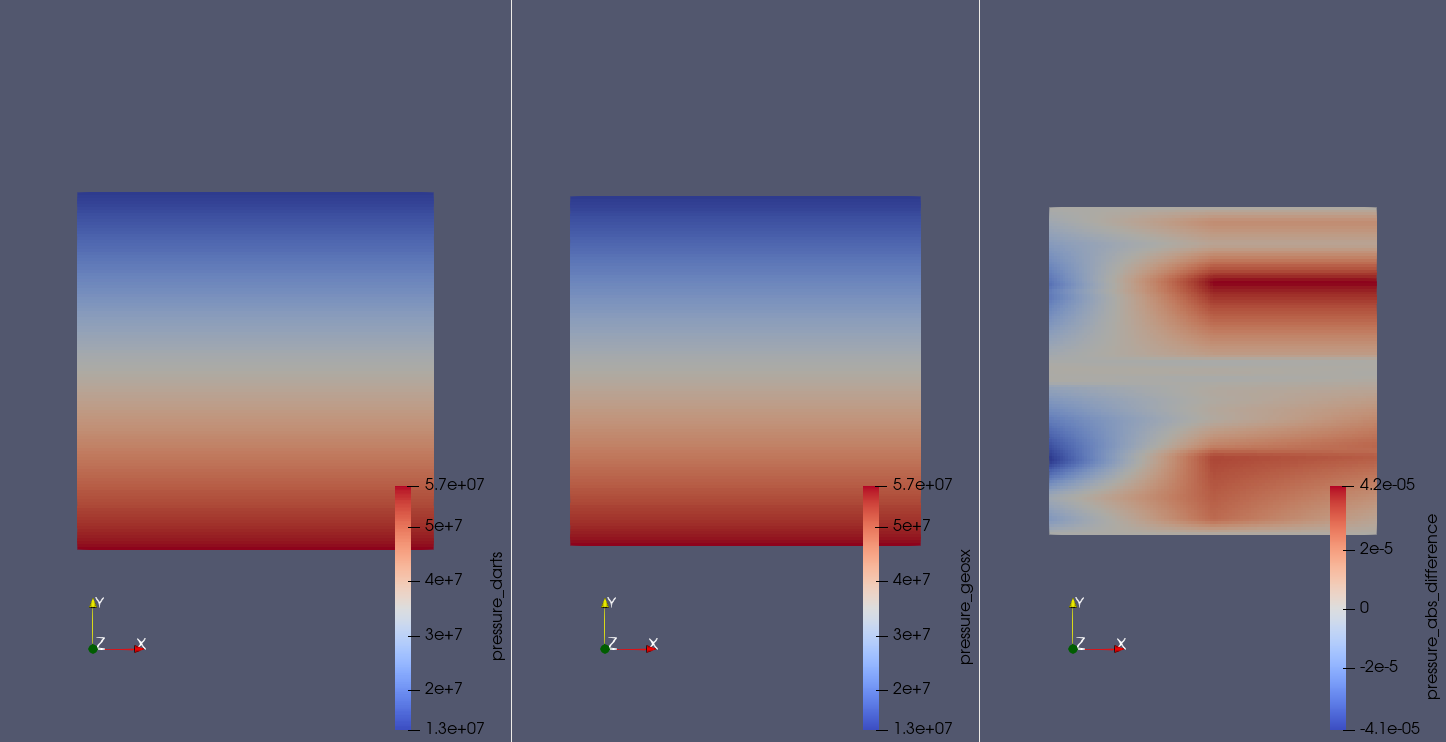
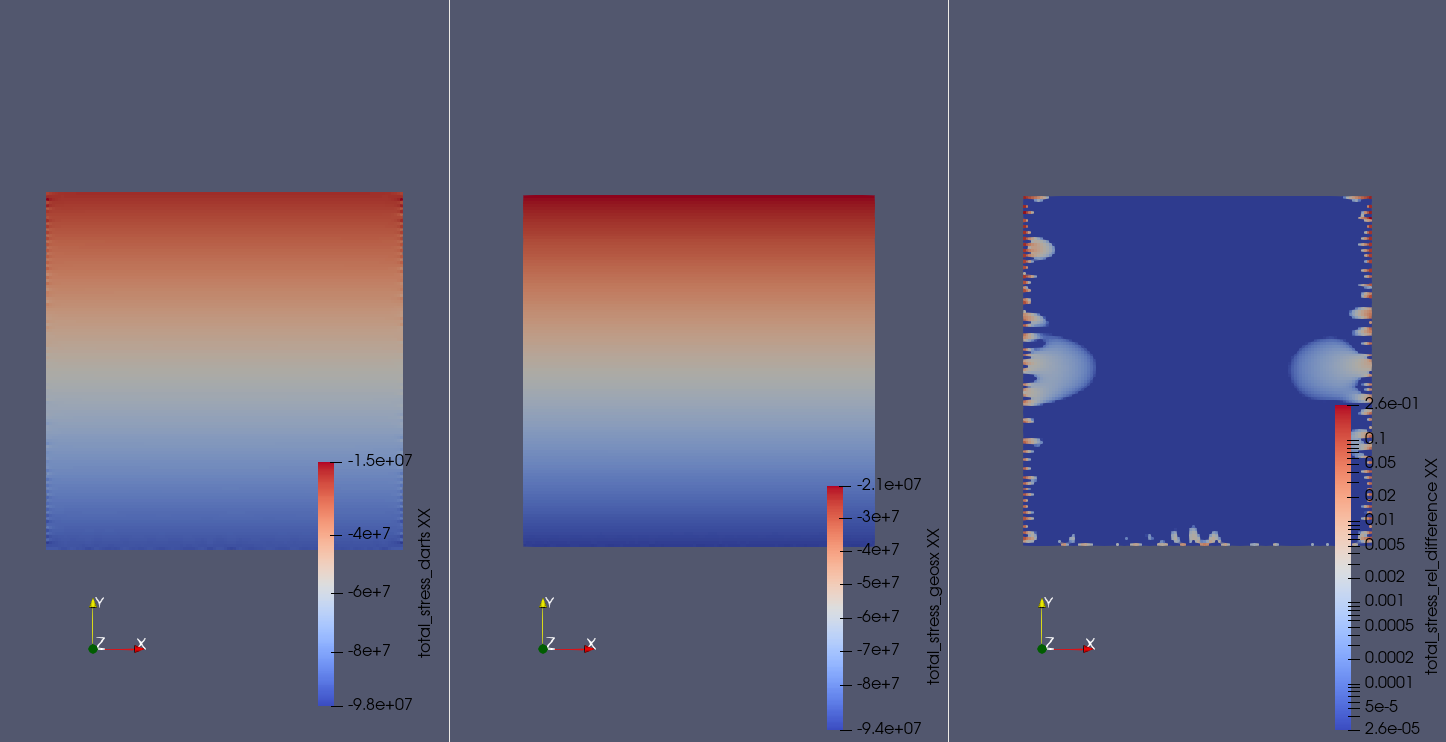
  2. In the case of plain strain conditions (zconstraint1 is activated) without fault (no fault segments), and no depletion, I made a comparison against DARTS (collocated FV). A snapshot with a comparison of pressures, total stresses, and displacements (linearly interpolated to cell centers) is here: https://drive.google.com/file/d/1_bwvoTC4F7RN8ungIZrfsbSaLXOJQTPE/view?usp=sharing
    Pressures and displacements fit each other quite well, there is a high mismatch in stresses close to the Dirichlet boundaries, it seems that cell-centered FV is less accurate there.
    displ
    pres
    sxx

  3. The problem is that I have not managed to achieve a convergent solution in the presence of a fault in both cases (before and after my commits). Now the residual cant decrease more than 200 times for me. Before my commits, it decreased by 10 orders of magnitude, but it still has not achieved the target. Both logs are attached.
    log_before_commits.txt
    log_current_state.txt

If it is easier to start debugging from the initial state, please, revert my commits.
I will think about how to assign pressure depletion in the reservoir.

Best,
Aleks

av-novikov and others added 26 commits January 19, 2023 16:21
…GEOSX/GEOSX into cusini1/feature/hydraulicApertureUpdate
@av-novikov

av-novikov commented Feb 23, 2023 •

Copy link
Copy Markdown
Contributor

It may be that LagrangianContactSolver::assembleStabilization creates problems with normal gap. But i struggle to understand what is going on there.

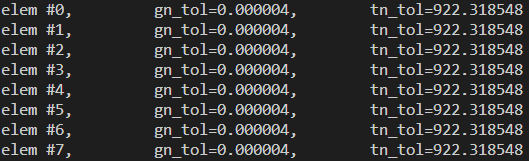
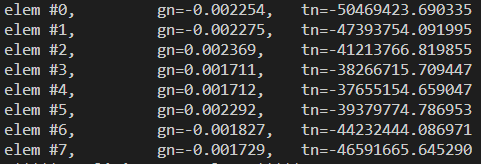
First I checked the tolerances for normal gap and normal traction in LagrangianContactSolver::computeTolerances. The one for the normal gap is much lower compared to the values we obtain (see below).
image

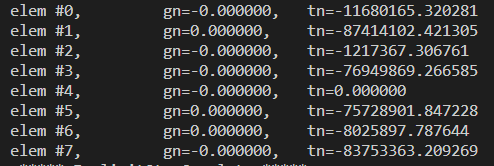
If I run verticalFault_puremech.xml it violates the impenetrability condition. Negative normal traction indicates the problem in the assembly of contact equations.
image

If I run verticalFault_puremech.xml with commented assembleStabilization in LagrangianContactSolver::assembleSystem it slowly converges to all zero normal gaps, even though normal traction is oscillating
image
It does not converge if i change friction coefficient. My point is that the contribution from assembleStabilization leads to much higher normal gap values than without it.

Generally, i do not understand why normal gap exhibits significant (compared to tolerance) changes while normal traction remains negative. Can anyone explain if/why stabilization can introduce it in a stick state?

@av-novikov

Copy link
Copy Markdown
Contributor

Now fluid pressure inside a fault is aligned with reservoir in verticalFault_poromechanics.xml. Unfortunately, it has not improved results.

Sign up for free to join this conversation on GitHub. Already have an account? Sign in to comment

Labels

None yet

Projects

None yet

Development

Successfully merging this pull request may close these issues.

4 participants