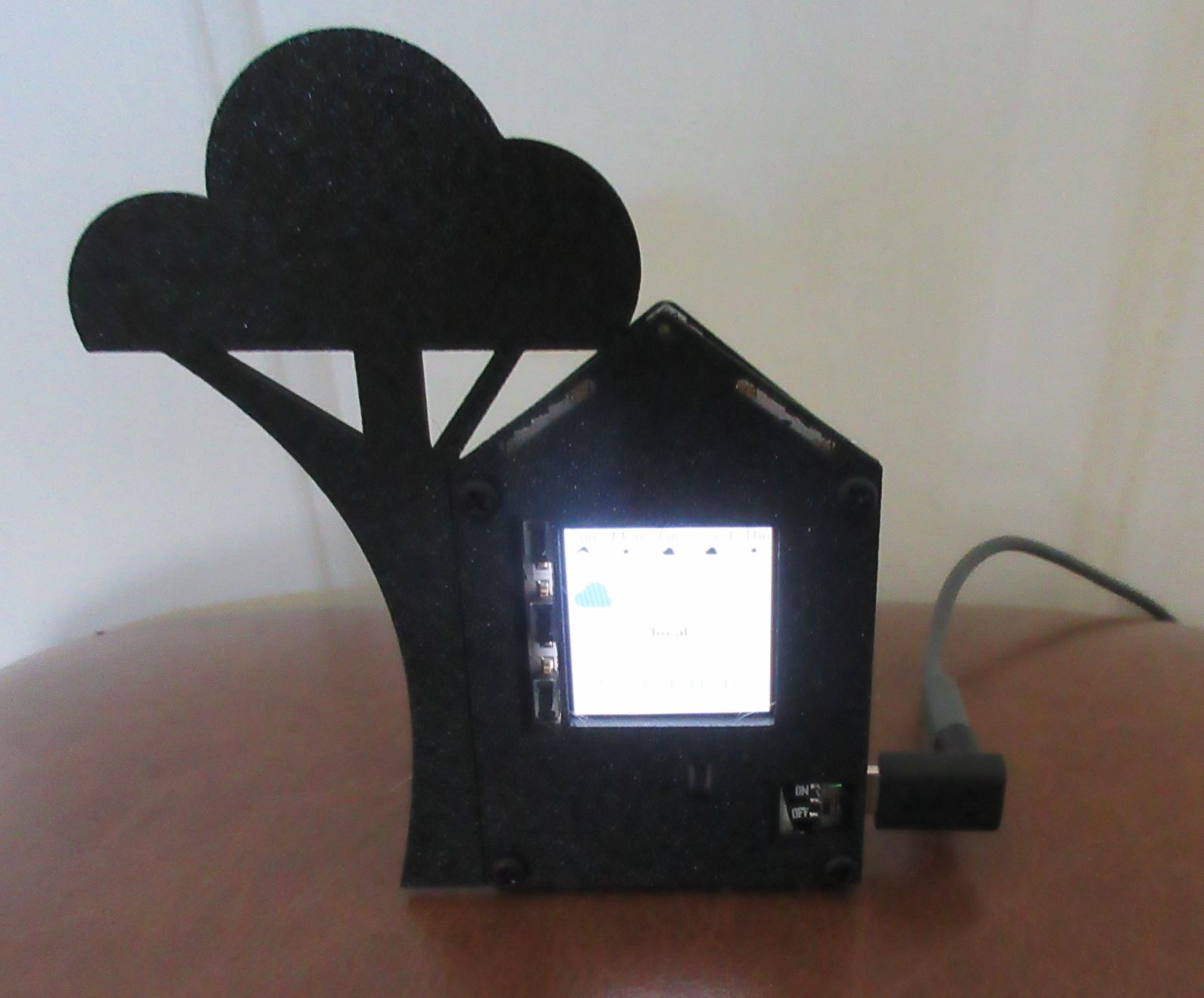
Adafruit FunHouse Board for a Weather and Clock Application switchable between four cities.
Weather forecast and NTP time for four locations along with local temperature, humidity and barometric pressure reading.
Built in buttons are used to
- change the location for the weather and time,
- select units between imperial or metric,
- refresh the screen.

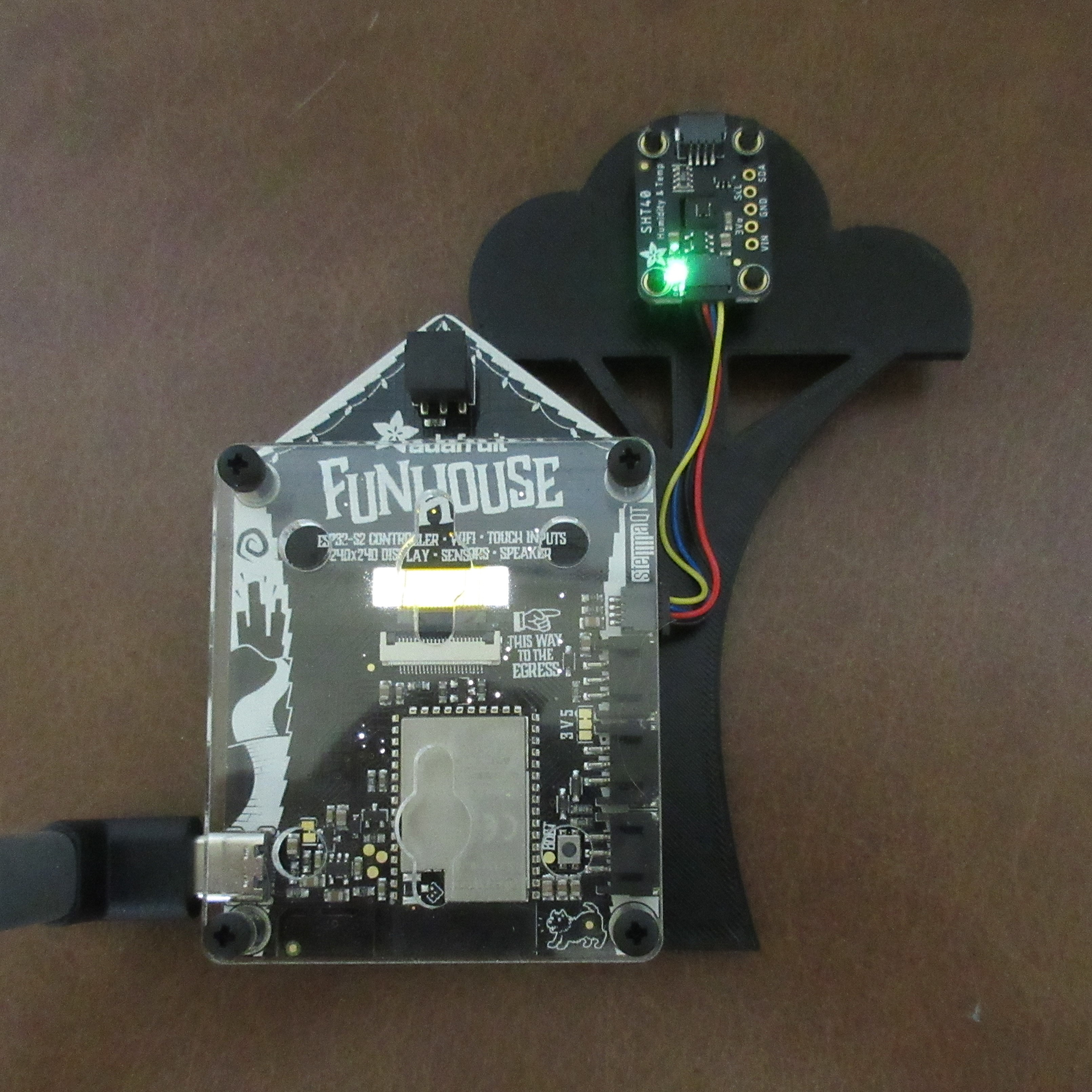
- Adafruit Funhouse Devboard: https://www.adafruit.com/search?q=funhouse
- To learn how to set up the board in Arduino: https://learn.adafruit.com/adafruit-funhouse
- Adafruit SHT40 Temp / Humidity Sensor: https://www.adafruit.com/search?q=sht040
- 3D printed faceplate \n
- Fusion 360 - FaceCover v11.f3d file
- 3D Printer Slicer file - FaceCover v11.3mf
The loop() function is structured in four tasks:
- Get weather forecast and update the weather display every 15 min
- Get time and update the time display every sec
- Read the SHT40 Temp / Humid sensors and update the display every 30 sec
- Read and update the barometric pressure every 20 min
The weather task takes up the most lines of code and is complex, but can be broken down as follows.
The task first calls the getForecast function which does these three things:
- Send a properly formatted get string to api.openweathermap.org
- Parse the JSON response - the parsing code was created using the ArduinoJSON assistant (ref: https://youtu.be/NYP_CxdYzLo and arduinojson.org )
- Copy the variables to be displayed into the a global struct variable named "weather".
Then, on return from the getForecast function, the task displays the weather data row by row. The getSymbol function maps the weather id returned from the API call into one of the weather types (SUN, CLOUDS, etc). The drawWeatherSymbol function then maps this to an associated glyph and displays it to the screen.
Time is updated using the network time protocal (NTP) servers and requires internet access. The library time.h is required. Here is what the code does:
- Connects to a WiFi network
- Configures the NTP servers using configTime() - example: configTime(0, 0, "pool.ntp.org");
- Updates the time using time() - example: time_t tnow = time(nullptr);
- Sets the time zone using setenv() - example: setenv("TZ", "PST8PDT,M3.2.0/2,M11.1.0/2", 1);
- Converts the time to local time and into a struct variable using localtime() - example: struct tm *timeinfo = localtime(&tnow);
- Draws the time and date to the screen
Here are some great references:
https://www.tutorialspoint.com/c_standard_library/time_h.htm
https://github.com/SensorsIot/NTP-time-for-ESP8266-and-ESP32
The built in AHT20 sensor consistently reads high - possibly because it picks up heat from the Funhouse PCB. Therefore, a separate temp / humidity sensor is attached off the board. The SHT40 was used since its I2C address does not conflict with the onboard AHT20 sensor.
Here is all you need to know to use the sensor. https://learn.adafruit.com/adafruit-sht40-temperature-humidity-sensor
The Funhouse has a built in DPS310. After installing the library, the example files provide all that is needed to use the sensor.
To interpret the readings, please see this reference: https://www.wikihow.com/Set-a-Barometer#:~:text=Predicting%20weather%20using%20a%20barometer%20is%20all%20about,release%20any%20pressure%20changes%20stored%20in%20the%20mechanisms
These rules are coded in:
  Falling
  If the reading is over 30.2 inches of mercury and falling rapidly, this indicates cloudy, but warmer weather.
  If the reading is between 29.8 and 30.2 inches of mercury and falling rapidly, rain is most likely on the way.
  If it's under 29.8 inches of mercury and falling slowly, rain is likely; if it's falling rapidly, a storm is imminent.

  Rising
  Readings over 30.2 inches of mercury that rise indicate that the weather will continue to be fair.
  Readings between 29.8 and 30.2 inches of mercury that rise indicate that the weather will remain whatever it presently is.
  Readings under 29.8 inches of mercury that rise indicate that the weather is clearing, but will be cooler.

  Steady
  A strong high pressure system is around 30.4 inches of mercury. Anything above 30 is considered high pressure.  Expect more warm weather.
  A typical low pressure system is around 29.5 inches of mercury. Anything below 29.9 is considered low pressure.  Expect cooler weather.
These barometer pressure weather predictions don't seem very accurate, but they are fun. Don't make any life altering plans based on these predictions :)