New architecture & Tests - #14
Conversation
Ideally tests will be discoverable as a package, and also won't be installed
via pip later down the line.

Now it should be possible to run `python setup.py test` without having to
install tests or tests requirements.
My tests need the module `responses` to run, as I use it to mock
`requests`. However, I changed things around so that the tests package
is not installed, and `responses` is not a dependency. It is however a
dependendency for testing in `setup.py`, so running
`python setup.py test` will install responses specifically for the tests.

My current solution is to make the Dockerfile install responses, and
hopefully that will work. I wonder if it is a bit of a hack though, and
if we should use `python setup.py test` as the testing mechanism.
I'm not sure!
| - docker-compose build sapi-python-client | ||
| script: | ||
| - docker-compose run --rm --entrypoint=flake8 sapi-python-client || true | ||
| - docker-compose run --rm -e KBC_TOKEN sapi-python-client -m unittest discover |
There was a problem hiding this comment.
needs to be KBC_TEST_TOKEN - my mistake, sorry about that
|
|
||
| WORKDIR /code | ||
| COPY . /code/ | ||
| RUN pip3 install --no-cache-dir flake8 responses |
|
|
||
| Args | ||
| root (str): Root url of API. eg. | ||
| "https://connection.keboola.com/v2/storage/" |
There was a problem hiding this comment.
the client must allow overriding of https://connection.keboola.com/ but not v2/ or /v2/storage/ part. The base url may change (actually we do already have https://connection.eu-central-1.keboola.com, but v2 is tied to API (and client) version
There was a problem hiding this comment.
In my mind the client constructs the string and passes it to the Endpoint. ie.
class Client:
    def __init__(self, base_url, token):
        api_version = 'v2/storage'
        root_url = base_url + '/' + api_version
        self.buckets = Buckets(root_url, token)
        ...
Does that work? Should API version also be a parameter? Or do you think each endpoint should construct the API string?
There was a problem hiding this comment.
yeah, that looks perffect, the api version should be hardcoded (there is no other version, not even in plans and when it will be who knows how it will look) and the endpoint should not repeat do the constructing
| self.path = urljoin(root, extension) | ||
| self.token = token | ||
|
|
||
| def _get(self, params=[], extra_headers={}): |
There was a problem hiding this comment.
i'd say we need dict to for params because of this http://docs.keboola.apiary.io/#reference/events/list-bucket-events/bucket-events-list or maybe better list of dicts because of wherevalues over here http://docs.keboola.apiary.io/#reference/tables/unload-data-asynchronously/asynchronous-export
There was a problem hiding this comment.
Maybe params is the wrong variable name for that argument. From what I can see, there are two types of params that can be passed: parameters which form the query string, like the parameters for list-bucket-events, such as sinceId etc; and parameters which go in the path of the url, such as workspace_id. The params arg as it stands it stands is solely for the latter, and maybe should be renamed. Query string params can be passed as a dict to requests.get.
Writing this code, and trying to made the Endpoint._get and Endpoint._post methods as versatile as possible it seems that we have to essentially replicate the requests.get and requests.post functionality which is redundant. I've been thinking about suggesting some changes in #6. the Endpoint class is still useful, but perhaps each endpoint subclass should be constructing its own requests, as they are so straightforward and the Endpoint superclass should instead implement response handling and header generation.
There was a problem hiding this comment.
I see the Endpoints _get() _post,... methods merely as a very thin wrappers for the requests native http methods, which only appends the X-StorageApi-token: TOKEN header to the request. I think it makes sense to delegate the url construction to the endpoints. And if some repetitive code appears, we can always refactor it into the base Endpoint class.
fwiw it's probably not even necessary to hide them with the leading _underscore but make them "public" i.e Endpoint._get(*args, **kwargs) --> Endpoint.get(*args, **kwargs).
There was a problem hiding this comment.
I think then that the base Endpoint get and post methods don't add any value. I do still think that the base endpoint class is still useful for a few things and I have half implemented some ideas, so hopefully I'll be able to share them in a few days.
|
|
||
| return r.json() | ||
|
|
||
| def _post(self, body={}, params=[], extra_headers={}): |
There was a problem hiding this comment.
come to think of it - wondering how to pass array parameters (whereValues) - http://docs.keboola.apiary.io/#reference/tables/unload-data-asynchronously/asynchronous-export
as it is now it would have to be - not sure how requests library handles those
There was a problem hiding this comment.
requests can handle array parameters, but it encodes the [] into %5B%5D. That should not be an issue for the storage api, right?
try this:
>>> import requests
>>> r =requests.get('https://httpbin.org/', params={'whereValues[]':['12','34','56']})
>>> r.url
'https://httpbin.org/?whereValues%5B%5D=12&whereValues%5B%5D=34&whereValues%5B%5D=56'
>>>
So really all we need to do is to expose the native requests functionality in the Endpoints get method and we should be good to go
There was a problem hiding this comment.
That will be ok for GET requests, but for array values in the form-data body I'm not sure. I see this in the docs
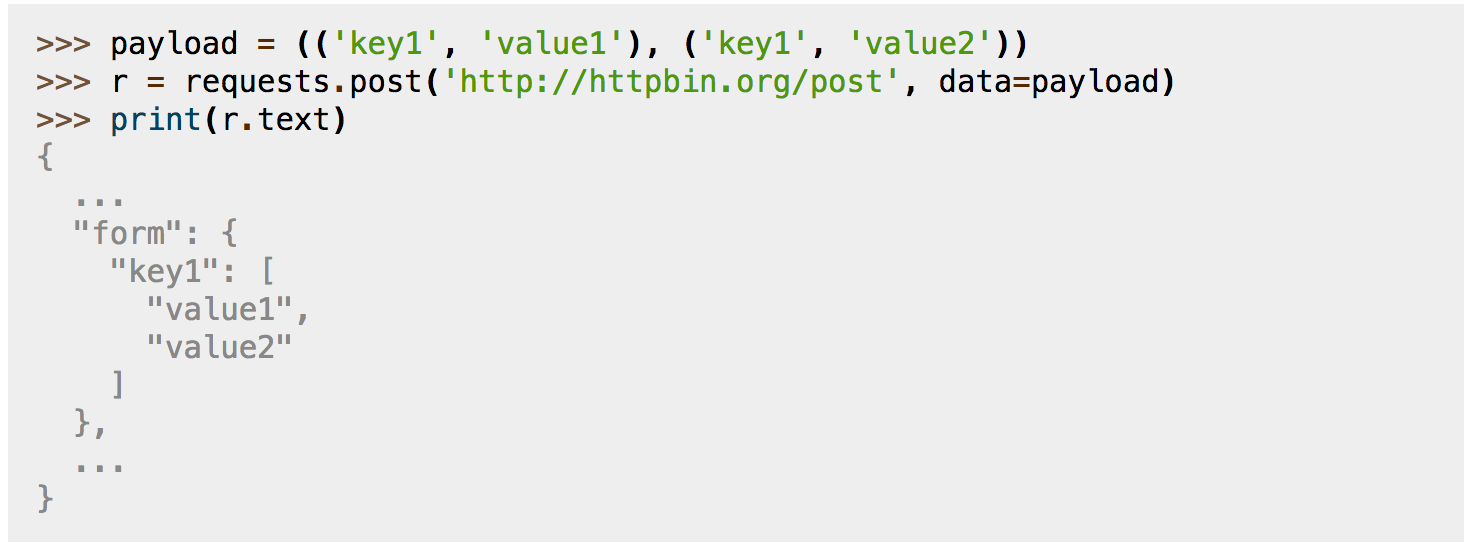
But it's something we'll have to try out.
Currently it constructs this manually which is obviously not ideal: https://github.com/keboola/sapi-python-client/blob/master/kbcstorage/client.py#L124
There was a problem hiding this comment.
@pivnicek I'm not sure I understand, sorry. When I try that code snippet I get this, which is what I would expect. Is this not what we want?
>>> import requests
>>> payload = (('key1', 'value1'), ('key2', 'value2'))
>>> r = requests.post('http://httpbin.org/post', data=payload)
>>> print(r.text)
{
  "args": {},
  "data": "",
  "files": {},
  "form": {
    "key1": "value1",
    "key2": "value2"
  }, ...
And @pocin that's what I found as well, arrays params for urls should be fine.
There was a problem hiding this comment.
@Ogaday there may be an issue may be with the whereValues in the request body http://docs.keboola.apiary.io/reference/tables/unload-data-asynchronously/asynchronous-export.
The backend expects it to be an array which is why it's constructed by hand that way currently. Maybe the requests library formulation (below) will work, but maybe not, we'll see :-)
{
   "whereValues": [
      "value1",
      "value2
   ]
}
| Workspaces Endpoint | ||
| """ | ||
| def __init__(self, url, token): | ||
| """ |
There was a problem hiding this comment.
I'm playing with the idea that it might be better to pass the endpoint class to workspace class as a ctor parameter - it's just that this way one has to pass the token all around the code and it's bound to leak somewhere...
There was a problem hiding this comment.
I'm not sure what that would look like.
How about passing the client to the endpoint as an alternative...
class Endpoint:
    def __init__(self, client):
        self.client = client
    def _get(self, url, *args, **kwargs):
        headers = {'X-SorageAPI-Token': self.client.token}
        ...    # etc

class Client:
    def __init__(self, root_url, token):
        self.token = token
        self.endpoint = Endpoint(self)
        ...    # ?
Or is that no better?
Maybe this can be taken up in #6
There was a problem hiding this comment.
hmm, I was probably thinking more like:
cl = new Client('my-token', 'https://connection') # <- only one place in code where token is passed to the client
workspace = new Workspace(cl)
workspace.reset_password()
configuration = new Configuration(cl)
configuration.get('my-config')There was a problem hiding this comment.
@odinuv so instead of passing the token to each endpoint you'd pass the client class, I don't see any benefit in that.
.. it's just that this way one has to pass the token all around the code ...
Not really, you would only pass the token in the Client.__init__() method, which would internally distribute it to the endpoints.
i.e
from urllib.parse import urljoin

class StorageClient:
    def __init__(self, token):
        self.base_url = 'https://connection.keboola.com/v2/storage/'
        workspaces_url = self.base_url
        buckets_url = urljoin(self.base_url, 'buckets')

        self.workspaces = Workspaces(workspaces_url, token)
        self.buckets = Buckets(buckets_url, token)
and use like this
>>> client = StorageClient('token123')
>>> client.workspaces.list()
{
    "id": 234,
    "name": "boring_wozniak",
    "component": "wr-db",
    "configurationId": "aws-1"
   # ... omitted for clarity
}
>>> client.buckets.list()
{ response listing all buckets }
I think this has several benefits, the client class is essentially your gateway to the world of the keboola storage api:
- you don't pass anything anywhere (tokens, clients,...)
- you don't have to import and instantiate the endpoints individually
- All endpoints are in one place, convinient and ready to use
Now when I am thinking about it, what would the Client class do in your example? To me it looks just like overly complicated conatiner for the base_url and token
class Client:
    def __init__(self, base_url, token):
        self.base_url = base_url
self.token = tokenThere was a problem hiding this comment.
I agree with @pocin - The token is only passed internally by the __init__ method of the client. Ultimately, the Endpoint instance needs to make a request with the token, so it needs access to it somehow.
I think having the capability to do client.endpoint1.list() and client.endpoint2.list() is very elegant :)
| Args: | ||
| mapping(:obj:`dict`): Keys contain the full names of the tables to | ||
| be loaded (ie. 'in.c-bucker.table_name') and values contain the | ||
| aliases to which they will be loaded (ie. 'table_name'). |
There was a problem hiding this comment.
table mapping has other parameters like days, rows, etc. while it is not important to support them now, the structure has to be extensible, i.e. i'd say it either has to be array of dicts (each wit keys source, destination, etc) or a designated object
There was a problem hiding this comment.
I definitely want to support those additional parameters because it's a use case I require personally but I don't think this is fully documented. I have link from keboola support which is helpful of course, but would be good to have a full spec.
There was a problem hiding this comment.
@Ogaday this is the API doc for the workspace load command http://docs.keboola.apiary.io/#reference/workspaces/manage-workspace/load-data. It could probably use a full example though. Is there a particular part that is missing for you?
There was a problem hiding this comment.
@Ogaday we already tracking that as "documentation issue"
There was a problem hiding this comment.
@ujovlado Thanks! I recognize your name from my support thread. I don't doubt that you are handling this :)
| mapping(:obj:`dict`): Keys contain the full names of the tables to | ||
| be loaded (ie. 'in.c-bucker.table_name') and values contain the | ||
| aliases to which they will be loaded (ie. 'table_name'). | ||
| preserve(bool): If True, does not clear the workspace of existing |
|
@Ogaday I think you did a Great Job! I left a bunch of notes, i hope it does not put you off. What if feel is missing:
|
|
Also with the mocks - they are good, but i wouldn't spent too much time on them. The client is and will be thin and it is most easily and reliably tested against the actual API, we are used to this. It's probably no problem for you to have a testing project for this. |
|
Thanks for the feedback @odinuv, it doesn't put me off at all :) I'll respond to the other comments in line above. Using mocks makes my life easier for now, happy to add real API call tests later too.
Good points, I'll look into these. I agree handling errors can wait a bit, as HTTP errors currently fail pretty fast! RE travis failures: I don't know enough about docker or CI to guess why the build process always fails whenever I commit anything. I don't suppose you know why this is either?
Not a problem, I'm taking a long weekend on Wednesday too |
|
You should be able to see the errors in https://travis-ci.org/keboola/sapi-python-client/builds/266261167?utm_source=github_status&utm_medium=notification - it's something wrong with the token, i'll check it |
|
Ok, i learned something new:
So the tests against real API won't pass in |
|
I found a crappy bug in my code and I've got some commits in the works so hopefully I'll make some pushes today |
Fix bug caused by mutable keyword arguments
Make the wrapper around the requests library thinner by delegating
argument construction to the childclass. This way the base Endpoint
class only forwards arguments to requests and then handles the
response. This also fixes the arguments for the base Endpoint
requests - no more mutable defaults!
Essentially, everything is being taken out of the client class. It
seems a lot of the functionality of the preexisting client was split
between different endpoints, so I have just started with buckets.
The tables endpoint looks a lot more complex!
|
I'm a lot happier with the code now. There is probably some repetition and doubtless some mistakes have slipped through, but I think we can refactor that / optimise it later. I did remove some functionality from the client class, for now, but I will focus on restoring it. Also as a priority / items to keep track of are:
I also tried to bring the existing bucket tests in line with the "new" architecture, but I don't know if they'll work on Travis or not. |
| except requests.HTTPError: | ||
| # Handle different error codes | ||
| raise | ||
| finally: |
There was a problem hiding this comment.
This is a fairly hidden gotcha. Instead of the finally write else. Otherwise the raised exception will be silenced by the finally.
This should work as expected
        try:
            r.raise_for_status()
        except requests.HTTPError:
            # Handle different error codes
            raise
        else:
            return r.json()
try this in your interpreter to see what I mean
class Resp:
    foo = 'bar'

def test(r):
    try:
        print(1/0)
    except:
        raise
    finally:
        return r.foo

r = Resp()

print(test(r)) #will print 'bar', but you would expect ZeroDivisionErrorThere was a problem hiding this comment.
Thanks, that is nasty! I wrote a test for it and hopefully fixed it.
| except requests.HTTPError: | ||
| # Handle different error codes | ||
| raise | ||
| finally: |
There was a problem hiding this comment.
same as above, just marking it
This tests the `try: ... except: raise finally: ...` gotcha caught
by @pocin.
|
I'm merging this so that I can make changes to it, I also made issues of the checklist (those I can imagine being 'delivered') |
I've been working on this throughout the week and think it could probably do with more work & reviewing before merging: I'd definitely appreciate feedback.
This PR is mostly a proof of concept of the architecture laid out by @pocin in #6: I've tried to stay close to the API and so you could call it quite a thin client?
I've also had a play with some tests. I used the very nice responses library to mock requests, and that way we don't need real tokens or even an Internet connection to test the client. In the tests you define what the API response should be and assert that the client isn't making any mistakes before or after calling requests. I think it might still be useful to have some real API calls to make sure everything is working sensibly, but I don't think I have access to the test environment.
I also modified
setup.pya bit. Essentially, previously upon install a package calledtestswas also being installed. Now, that should no longer be the case. If you want to run the tests, you should clone the directory and run them. There are several options for running tests:After
pip install responses, door
or
or
etc.
Alternatively, without needing to even install the package:
Which takes care of all dependencies.